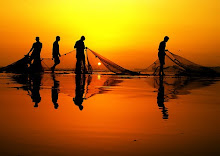
After he had finished speaking, he said to Simon, "Put out into deep water and lower your nets for a catch." Simon said in reply, "Master, we have worked hard all night and have caught nothing, but at your command I will lower the nets." When they had done this, they caught a great number of fish and their nets were tearing. - Luke 5:4-6

Sunday, August 29, 2010

Congrats Paul


Yesterday my brothers in Holy Cross and I, along with many of our family members and friends had the pleasure of witnessing the Profession of Perpetual Vows of Paul Ybarra, C.S.C.  The Profession of Final Vows is always a highlight of the year and a great witness for those of us in formation.  To see someone, similar to us in many respects, and for those of us who have been in formation a while, someone who is a good friend and brother in community, give the entirety of his life to Holy Cross, in service of the Lord is always an amazing shot in the arm and a great reminder of why we chose to be in Holy Cross and the true purpose of our formation.

Today we get to see Paul make yet again another public commitment in service to the Lord and His Church as he is ordained a deacon.  As a deacon Paul will serve both in Sacrament and in Word to the people of God. 

Congrats Paul and thanks for the great witness of your life in Holy Cross

Friday, August 27, 2010

A Check-In with the Abbot

Yesterday I took a little break from the Notre Dame break and ventured to Lisle, IL to see Abbot Austin, OSB, at St. Procopius Abbey.  Abbot Austin was just Fr. Austin when he resided at Moreau for a couple of years while working on his PhD in Patristic Theology.  As mentioned in an earlier post Abbot Austin was supposed to be with us this year as well as he finished up his doctoral dissertation, but over the summer grace intervened and he was elected the Abbot of his monastery.  Unfortunately I won't be around for his Abbatial Blessing on September 18, so I decided to use the opportunity of being at ND to take an evening to visit him.  The Abbey is only two hours from South Bend, but many more from Phoenix.  I joined the monastic community for mass, dinner, and vespers on Thursday evening and left after lauds and breakfast this morning.  I also got some time to tour the Abbey, catch up with Abbot Austin, and even get my copy of The Rule of St. Benedict signed by him.  Even though it was a short stay, it was a time of great grace, relaxation, and sleep.

Thursday, August 26, 2010

A Note on the Roman Missal


As many of you have already heard, H.E. Francis Cardinal George, President of the United States Conference of Catholic Bishops recently announced the First Sunday of Advent of 2011 (or November 27, 2011) as the implementation date of the Third Typical Edition of the Roman Missal in the United States.

Many are asking why do we need a new translation, why now at a moment when much of the English church is struggling and why change what we are used to.  Hopefully this brief explanation of the process will help answer some of those questions.  The decision to revamp the language of the mass was not a decision in and of itself, but rather the confluence of a series of events.  After the Second Vatican Council and in accordance with the liturgical reforms laid out by the council fathers Pope Paul VI promulgated the new Roman Missal in 1969, this was the First Typical Edition of the Roman Missal ("typical" here is for the most part synonymous with the word "standard").  Many committees based on language group were formed to translate the Missal from its original Latin into the various languages of the Church, this first time ever this was done.  The English translation of that Missal is the one that we have grown to know and love over the course of the past forty years.  In 1975 the Missal was revised a bit and a Second Typical Edition was promulgated by Paul VI.  The revisions to this edition were relatively minor and thus the English Missal simply maintained the translation that already existed and only tweaked where the original Latin was tweaked.  In 2002 Pope John Paul II promulgated the Third Typical Edition of the Roman Missal.  Again in the original Latin the changes were relatively minor, the addition of a few new saints on the Roman Calendar and the clarification of a few practices in the Preface or the General Instruction (these practices, such as bowing during the words "he was born of the Virgin Mary and became man" during the recitation of the Creed, have already been implemented).  However in 2001 the Holy See issued a document entitled Liturgiam Authenticam regarding the use of the vernacular in the books of the Roman Liturgy. 

This document called for a closer translation of liturgical books from the original Latin text into their respective vernacular languages.  For the many folks who speak the romance languages this is no large issue because the root of their language is Latin and the translation is fairly easy and accurate.  However for those of us who do not speak a romance language the task of translation is far more tedious and complicated, as we try to capture sentiments expressed by expressions, sentence structures, and verb constructions that simply do not exist in our language.  Liturgiam Authenticam asked that the translations of new liturgical texts be kept as true to the original Latin text as possible.  This meant that when the Third Typical Edition of the Roman Missal was promulgated in 2002, we were not able to simply able to tweak what we already had in English, but needed to take a serious look at what our English translation said and whether or not it could be improved.  When the original 1969 Missal was translated the process focused on trying to best capture what was said in Latin using common English parlance. What resulted was a translation that was fairly intelligible and mostly captured the gist of what the Latin text is trying to say.  This process too was not perfect and some of the translations in the Missal we have been using since that time have felt inadequate.  The best way to demonstrate the differences in how we translate Latin into English would be through an example. 

The greeting and response we all know well from mass is: “The Lord be with you…and also with you.” The Latin text for this greeting has always been “Dominus Vobíscum…et cum spíritu túo.”  Even with a modicum of Latin, or for that matter Spanish, Italian, or French, it is easy to see that the word “spirit” appears in the Latin and not in the English.  In the new translation the response to “the Lord be with you” will now be rendered as “and with your spirit.”  Thus the new translation in a sense more closely follows what is in the Latin.  Again for our Spanish speaking brothers and sisters the response to “El Señor esté con ustedes” has always been “Y con tu espíritu,” which rendered into English is also “and with your spirit.” 

Now there are many legitimate arguments regarding dynamic equivalence and formal equivalence and which sort of translation is more beneficial to the English speaking Church.  This is an argument I will not get into, given that much has already been said by much more knowledgeable people than I.  However it should suffice to say that this process of translation took a lot of time and has certainly not been without controversy as many bishops and scholars discussed how to best capture the Latin text of the Roman Missal and as stated above the Holy See has finally approved the final product.  The new translation will be a big change for the Church in the English speaking world, like all human endeavors this translation is not perfect and adjusting to it is going to be a challenge for all of us.  However this new translation also provides the English speaking Church with many beneficial opportunities as well.  It will give all of us the opportunity to listen more attentively at mass as we adjust to the new language.  We know well how easy it is to get distracted during mass, we start thinking about the Jets game that afternoon and before you know it we are at the Our Father. As we implement the new translation we will have to chance to be captivated by the liturgy as we listen for and adjust to the new language. 
The language itself will be a bit wordier, often times making the prayers more poetic and beautiful, but also at times making them more verbose and a bit wordy.  Though it is often difficult for us to grow into change, our transition to this new translation will be much easier if we come to it with open minds and hearts.  There are many beautiful elements to the new translation and it would be a shame if we missed them due to our own anger or hesitation over a new translation.

It is also important for us to remember that we are not changing the Mass.  The Eucharistic Sacrifice was given to us by Jesus Christ and is eternal and unchanging.  Though the specific wording and gestures we use might change from time to time, the inherent nature of the Mass does not.  While the way Mass sounds might be different and the words might be a bit more formal and academic, we need to remember that the Mass itself is still the same, that Christ is still present, body, blood, soul, and divinity in the sacrifice we offer.  As we begin the transition to a new translation may we keep in mind just how great a gift we have been given in the Eucharist itself.

For those who are interested on reading more on the topic, the USCCB has put together a very nice website (complete with countdown clock) at www.usccb.org/romanmissal/

Tuesday, August 24, 2010

Deer Porte 2010

Our panelists, Bro. Rodney Struble, CSC, Fr. Bil Melody, CSC,
and Fr. Rich Bullene, CSC.
On August 10, I left Phoenix for Notre Dame so that I could join my brother seminarians at our annual camp in La Porte, IN, affectionately known as Deer Porte (our previous camp location was called "Deer Park" so we merged the two names).  Camp has been a long and somewhat storied tradition among Holy Cross Seminarians and more about it can be read over at the CSC vocations blog.  Essentially camp is a time for the seminarians to gather before the beginning of each academic year and spend some time together, getting to know the new seminarians and catching up with the other seminarians after a summer apart from each other.  There is a lot of time for recreation: bocce and corn hole tournaments, a fishing derby, just sitting around the pool chatting, but there is also time spent in orientation meetings as each formation program starts its year and also time spent in prayer and reflection. Every camp is given a theme to guide the seminarian's reflection and different speakers and panelists give talks to give us something to chew on over the course of the week.  My classmate, Matt Kuczora, CSC was this year's camp mayor and did a wonderful job.  We had lots of fun, but also fantastic presentations as well by our guest speakers.  However, I have to admit that one of the best parts of camp this year was spent not at camp, but was our free day where a few of the other seminarians and I headed into Chicago to visit the Museum of Science and Industry.  This was the one major Chicago museum that I hadn't been to yet and it was loads of fun.  Where else can you walk through a real life German U-boat one minute and a 727 the next!


We returned from camp on August 18, and for my brother seminarians the time between then and now has been spent preparing for the start of the academic year.  I have been doing my best to get any work for the parish that can be done off site done, but I have also spent much time with many of my friends here at Notre Dame, making sure I see them before I leave for Phoenix again.  I will return to Phoenix on Monday after Paul's profession of perpetual vows.  However more on that as they come.  My next major event is a trip to Lisle, IL, a western suburb of Chicago to visit a benedictine monk, who lived with us at Moreau last year, but was elected abbot of his monastery over the summer.


 Photo Credit: Ryan Pietrocarlo

Monday, August 23, 2010

Sorry for the hiatus

Well folks, sorry for the month long hiatus.  My commitment to keep the blog updated weekly totally flew out the window as I began to settle into the parish this page got put on the back burner.  It also did not help that Blogger is blocked by the diocesan web server, which is the only internet service available at the parish at the moment.  I am currently at Notre Dame, where all the seminarians spent a week together at camp and are now preparing for the start of classes as I have a little free time as I wait here at ND until next week so I can witness the Profession of Perpetual Vows of Paul Ybarra, C.S.C., my predecessor seminarian at St. John Vianney.  More to come on those events as they happen, but now without further ado, a recap of the past month.

I left New York on July 14 for Goodyear, Arizona and my home and apostolate for the upcoming year.  I was met at the airport by. Fr. John Herman, C.S.C., my pastor and supervisor for the year, who took me to my new home.  For those who don't know the Phoenix geographic layout.  Goodyear is a township/outer suburb to the west of Phoenix.  Chandler, Tempe, Mesa are on the eastern side of Phoenix and Avondale and Goodyear are on the western side.  The parish is currently in the middle of expanding and renovating the rectory (the house where the priests live) so I moved into a house that is usually used to hold retreats and meetings on a temporary.  Hopefully the rectory should completed by mid September.  Here are a couple of pictures of the rectory during the renovation process:

 The original part of the rectory, now gutted.
 
The addition to the rectory, which is under construction, from the original rectory.


 The addition from the back looking at the original rectory. 

Two weeks later, framing is up in the addition.

What will be the chapel, framed and ready to go.

My main goal for my first month at the parish was just to get to know the parish, to get to know the parishioners and the many different groups and ministries at the parish.  With a parish that is 4,500 families large, it's not the easiest task, but one that is extremely worthwhile.  I also started getting my feet wet in the various groups, ministries, and responsibilities I will be a part of or responsible for over the coming year.  This included going to a fair bit of meetings as well as starting to preach, presiding at a wake and going along with the pastor to another, and one burial.  This small taste of parish life so far has made me very excited for the many opportunities that will present themselves in the upcoming year.  The last notable event of my first few weeks at the parish was the arrival of our new associate pastor, Fr. John Korcsmar, CSC, who arrived about two weeks after I did.  Needless to say Fr. John Herman and I were very excited to have Fr. John K, with us not only to help us with the work of the parish, but also to complete our local CSC community.  On August 10 I left for Notre Dame to join the rest of the seminarians at camp, but I will cover that in the next post, which will be soon.

Wednesday, July 14, 2010

Family Outing

Alas, I am blogging from the air again, I am currently en route to Phoenix but I figured I would take the time to give a brief update on the goings on of my past week.  The ND savvy out there will probably recognize the statue in the above photo and probably recognize that it is not the one in front of Corby Hall, so yes you're right, we took a family trip to Gettysburg.  In all honesty it was originally billed as a family trip to Hershey Park and the Gettysburg leg (which is about an hour away) was added on later, at your author's humble request.  Hershey has been a place where my family has spent many a summer vacation and it is always nice to go back.  However with me at 25 and my brother at 21, this trip, while certainly still fun, brought the realization that our Hershey days are probably behind us and it is up to my brother to have kids of his own before we head back again.  But that being said, there are still some awesome roller coasters at Hershey that still give a thrill to children of all ages. 

Our time at Gettysburg was short (about4.5 hours) but extremely worth while.  It was my first trip to the famous battlefield and was certainly worth it.  I guess what is most striking is the sheer size of the battlefield, which took nearly 2 hours to drive around.  Equally striking was the absolute skill (and bit of luck) that was needed for the Union to be victorious.  As our tour guide drove us around the battlefield and outlined each phase of the battle it became apparent just how close the Union came to losing the Battle of Gettysburg, a possible history changing outcome.  However it is not the bravery and determination of the Union soldiers alone that makes Gettysburg sacred ground, the land is a great reminder of what the consequences of a divided nation can be.  A place where thousands of Americans, both Union and Confederate died in service to their country.

Wednesday, July 7, 2010

Final Reflections on Mexico


All in all Mexico was a fantastic experience.  Not only was it an opportunity to learn Spanish, but also an opportunity for Chris and I to experience the Mexican culture and to begin to understand a bit, not only the language but also the cultural base of the many Mexican Americans we minister to and with here in the United States.  Speaking of Chris, I cannot thank him enough for being pretty decent company for 6 weeks in a foreign country and for his kind and gentle forbearance.  We did pretty well considering we made up about 75% of each others' English conversation for 6 weeks.  Thanks must also be given to the many other seminarians who eventually joined us at CIRIMEX, there was a large group from the St. Paul's Seminary, St Paul, MN and from St. Meinrad's, Mundelien, and St. John Vianney in Denver.  They are just great guys in general and very much brought some welcome company and fellowship at the language school.

The program itself was intense to say the least.  Four hours of grammar instruction in the morning and 2 hours of conversation in the afternoon.  All the sessions were one on one just me and the teacher meaning there was really no opportunity to take a rest at all and of course after school was over we all went home to speak more Spanish.  The students often joked that the 30 minute break in the morning was the best part of the day, but truthfully, it was the one point in the day when we didn't have to think about Spanish at all.  However in reality this was probably the best way to learn, basically forcing myself to start thinking in Spanish.  I am certainly much more confident (and hopefully a bit better) with my Spanish after my time at CIRIMEX.  I also cannot thank my two teachers Aurea and Rosy for their patience and gentle guiding hands.  They really did help a lot.

The time also allowed us to get to know the people of Mexico and experience some of the great beauty of the country.  Mexico is certainly a country that has its fair share of problems, we have all seen what great evils the drug cartels have brought and how a culture of corruption among the police and government makes the drug problem and many others worse.  However at their heart the people of Mexico really have a lot going for them.  They are a people of great faith, passion, and devotion and a country of great natural beauty and resources. Mexico was an excellent host to Chris and I over 6 weeks and we are certainly much richer for the experience.